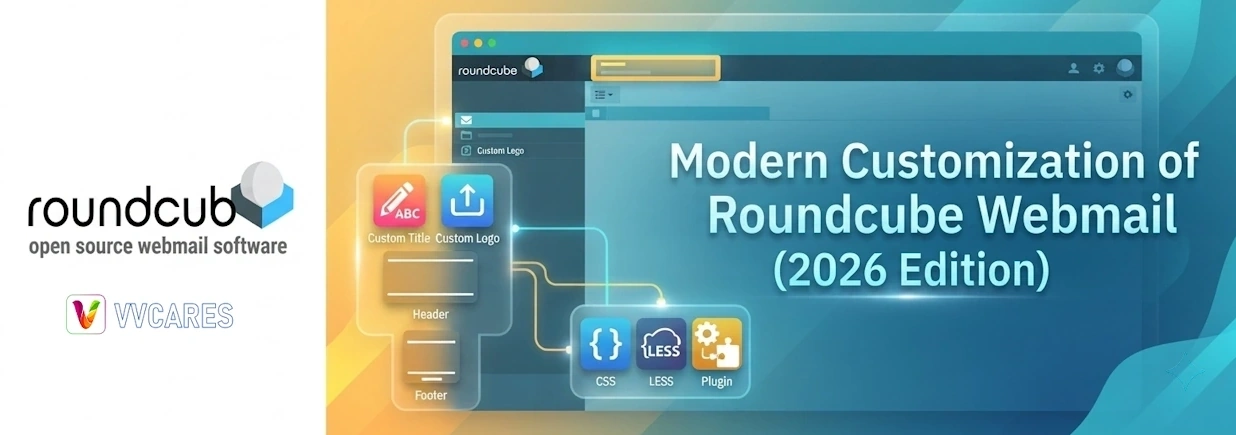
Roundcube has long been the gold standard for open-source, browser-based email. Its lean performance, reliable architecture, and feature-rich interface make it the go-to solution for developers and business owners who prefer to maintain control over their mail servers.
However, the default “out-of-the-box” Roundcube interface, while functional, lacks the brand personality that modern businesses require. In this guide, we provide a deep dive into the 2026 best practices for customizing the Elastic skin, focusing on sustainable, professional methods—including the advanced technique of creating a Custom Plugin.
1. The Power of the “Custom Plugin” Method
The most “EEAT” (Expertise, Experience, Authoritativeness, Trustworthiness) way to customize Roundcube is to avoid editing core files entirely. By creating a custom plugin, you “hook” into the Roundcube rendering engine. This ensures your branding survives future software updates without having to manually re-apply changes.
How to Create Your Branding Plugin:
-
Create the Directory: Navigate to the
/plugins/directory in your Roundcube installation. Create a new folder namedmy_brand_customization. -
Define the Plugin: Inside that folder, create a file named
my_brand_customization.php. -
Add the Logic: Use the following PHP structure to inject your custom CSS or HTML:
PHP<?php class my_brand_customization extends rcube_plugin { public function init() { $this->include_stylesheet('style.css'); $this->add_hook('template_object_footer', array($this, 'add_custom_footer')); } public function add_custom_footer($args) { return array('content' => '<div class="custom-footer">Powered by MyBrand © 2026</div>'); } } -
Enable the Plugin: Open
config/config.inc.phpand add'my_brand_customization'to the$config['plugins']array.
This method is “future-proof.” When you update Roundcube, you simply copy your plugin folder over, and your branding remains perfectly intact.
2. Navigating the Elastic Skin Structure
If you have used older versions of Roundcube, you might remember the “Larry” skin. That era has passed. Today, the Elastic skin is the standard. It is fully responsive, meaning it adapts to desktops, tablets, and mobile phones seamlessly.
To begin any customization, you must navigate to your Roundcube installation directory: /your-roundcube-path/skins/elastic/. Within this directory, you will find:
-
/styles/: Contains the CSS and LESS files governing the visual design. -
/images/: Holds the logo, icons, and background assets. -
/templates/: Contains the HTML structure of the interface.
3. Professional Logo Replacement
Many guides suggest simply overwriting the logo.svg file found in the /images/ folder.
The Professional Approach:
-
Preparation: Your custom logo should be a high-quality SVG file to ensure it remains crisp on high-DPI displays.
-
Maintaining Dimensions: The Elastic skin uses complex flexbox layouts. If your new logo has different dimensions, it will break the header’s alignment.
-
Naming Convention: Keep a copy of the default logo and name your new file
logo_brand.svgto make troubleshooting faster.
4. Modern CSS Styling: The LESS Pre-processor Method
In 2026, directly editing the styles.css file is considered a “bad practice” because future updates may overwrite your changes.
The Sustainable Way:
-
Find
_variables.less: Located inskins/elastic/styles/. This file holds the color palette, font sizes, and layout variables. -
Apply Overrides: Create a new file named
custom.lessin that same folder. -
Linking: Import your
custom.lessinto the mainstyles.lessfile. This ensures your custom styles are loaded after the defaults, effectively overriding them without losing modifications during upgrades. -
Compilation: If you have command-line access, run the build script (
make css-elastic). This is the “official” way to compile your LESS changes into valid, high-performance CSS.
5. Troubleshooting Common Pitfalls
Customizing webmail is a delicate process. Here are three common issues and how to solve them:
-
“My changes aren’t showing!”: Browsers aggressively cache CSS and image files. Use “Incognito” mode or clear your browser’s cache.
-
“The layout is broken on mobile.”: Use a “media query” in your
custom.lessfile to cap the width of your logo on mobile devices. -
“I lost my changes after an update.”: This happens if you edit core files instead of using the Plugin method. Always maintain a backup of your
/plugins/directory and your custom CSS files.
Why Technical Integrity Matters
Building a professional web infrastructure requires more than just making things “look pretty.” It requires maintaining the underlying code integrity. By using LESS and plugins, you ensure that your Roundcube instance remains secure, fast, and easy to maintain.
At VVCARES, we understand the nuances of managing high-performance Linux servers and webmail infrastructures. Proper customization isn’t just about branding—it’s about optimizing your workflow and ensuring that your digital tools work as hard as you do.
Need Expert Assistance?
If your business requires a custom-branded email solution, or if you need help securing and optimizing your mail infrastructure, do not hesitate to reach out. We specialize in custom software, SEO, and robust server management.
For reliable infrastructure support and web development, visit VVCARES.COM.
Frequently Asked Questions (FAQ)
Q: Do I need to be a developer to customize Roundcube?
A: Basic logo swaps are beginner-friendly. However, modifying LESS files or creating plugins requires a fundamental understanding of PHP and CSS.
Q: Is it possible to change the color scheme entirely?
A: Yes. By editing the variables in _variables.less (or your custom.less override), you can shift the entire UI to your brand’s color palette in just a few minutes.
Q: What is the benefit of the Plugin method over editing HTML?
A: Stability. Editing core HTML files means you must manually re-apply your changes every time you update Roundcube. Plugins are decoupled from the core files, allowing for seamless updates.
Q: Is Roundcube still secure in 2026?
A: Yes. Roundcube remains highly secure, provided you keep your installation updated to the latest stable release. Customizing your skin via safe methods (Plugins/CSS) does not compromise your security posture.